

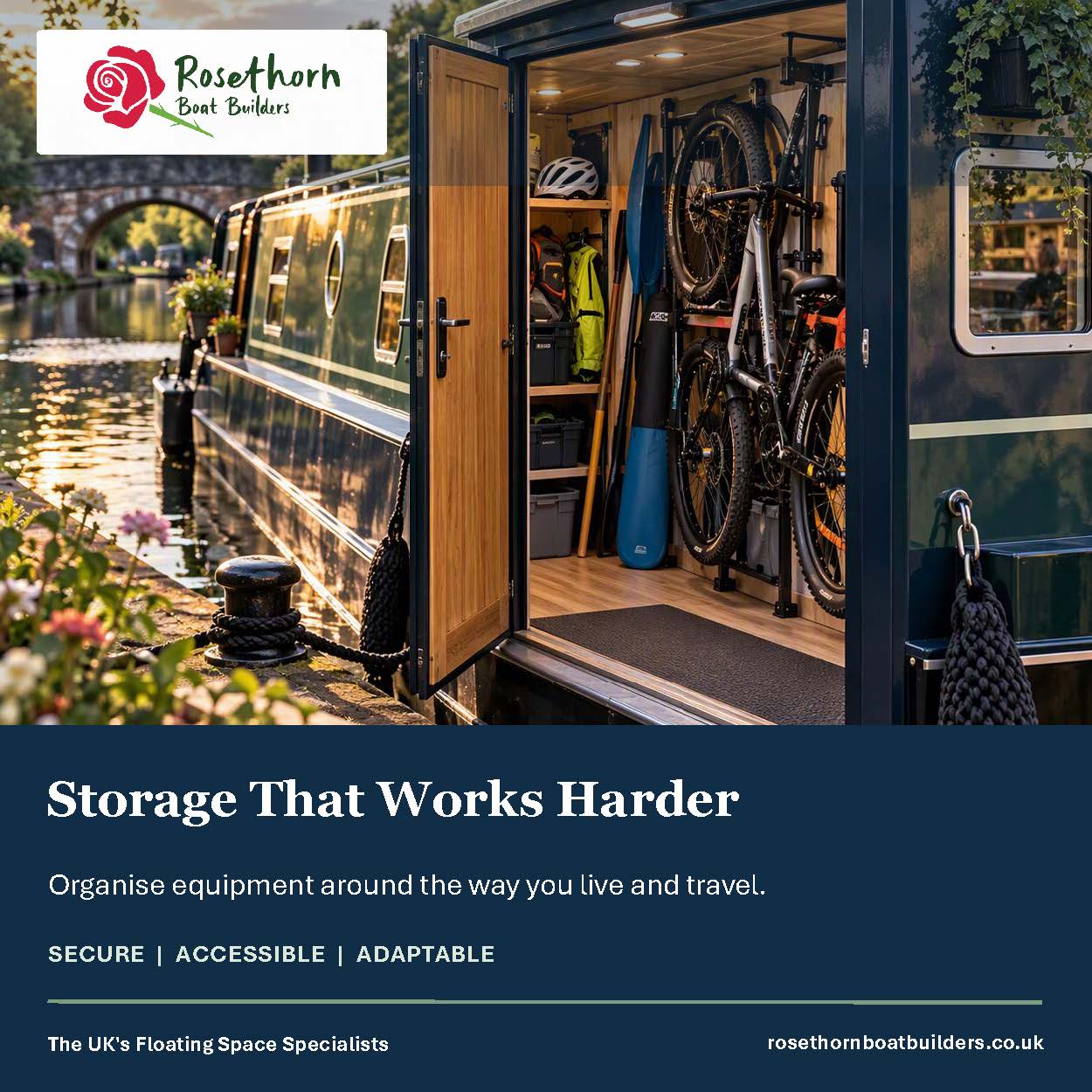
 Conceptual image.
Paddleboards in the cabin? Bikes on the roof? Wet kit with nowhere to dry?
Rosethorn can create a compact floating base designed around the equipment, routines and adventures that are currently competing with your living space.

Life on the water often comes with equipment. Paddleboards, bikes, wetsuits, helmets, buoyancy aids, tools and outdoor gear can quickly consume the space that made boat life attractive in the first place.
A purpose-designed butty barge can move selected equipment out of the main boat while keeping it close to the water and ready to use. The aim is not a large sports centre. It is a compact, organised base, potentially up to approximately 25 ft, designed around the activities you actually enjoy.
• Paddleboards, paddles and pumps
• Wetsuits, boots and buoyancy aids
• Helmets, ropes and safety equipment
• Bicycles and e-bikes
• Fishing and outdoor equipment
• Tools, spares and maintenance kit

The strongest layout begins with the equipment dimensions. Rosethorn can plan racks, vertical storage, access doors and wet-kit areas around the items that need to move in and out regularly.
Inflatable equipment can often be easier to accommodate internally. Larger rigid kayaks, canoes and boards may be better supported with external or adjacent arrangements, depending on the site and final concept.
• Board and paddle racks
• Pump and accessory storage
• Buoyancy-aid hanging space
• Dry-bag and helmet storage
• Repair and maintenance shelf
• Wet and dry equipment zones

Where do your bikes go? A floating equipment barge can create a dedicated space for cycles and adventure gear without filling the saloon, blocking circulation or relying on exposed outdoor storage.
The design can consider the full movement of the bike through the doorway, turning space, rack arrangement, security and appropriate charging requirements for e-bikes.
• Floor or wall-mounted cycle racks
• Lockable equipment storage
• Helmet and clothing zones
• Maintenance bench and tools
• Charging positions where appropriate
• Wide access planned around equipment dimensions

For commercial and organised activity, the barge can become a compact operational base close to the launch point. The focus should remain on practical functions that fit the available footprint.
• Customer check-in or booking point
• Instructor and safety-equipment store
• Hire-equipment issue and return
• Session preparation area
• Small retail display for accessories
• Briefing material and administration storage

Marina operators can use watersports and adventure spaces to improve facilities for existing customers or create a berth for an activity provider. This links directly to Rosethorn’s marina and referral-partner audience: the marina supplies location and customer access, while the floating space provides a clearly defined facility.
Potential models include marina ownership, tenant lease, club use or a partnership with an independent activity operator. Any commercial arrangement should be defined before the final specification is agreed.
• Berth-holder equipment storage
• Paddle or cycling club base
• • Hire and tuition operator unit
• Shared watersports storage
• Adventure-business concession
• Marina-owned rental facility

Rosethorn starts with a list. What needs to fit? How big is it? Is it wet or dry? How often is it used? What needs charging, securing, washing or repairing?
That inventory helps turn a compact barge into organised usable space rather than another place where equipment is simply stacked.
• Purpose-sized shelves and racks
• Robust doors and secure locking points
• Durable floors and wall finishes
• Ventilation and drying considerations
• Task lighting and power
• Bench space for preparation and repair

The watersports and adventure concept fits Rosethorn’s wider promise: more space without replacing your boat. It gives active boat owners somewhere for the equipment that supports their lifestyle, and it gives marinas and operators a new type of practical waterside facility.
Start with the activity and the equipment rather than the boat specification. Rosethorn can then help turn the requirement into a focused brief and an appropriate floating-space concept.
• Activity and user brief
• Equipment and dimension schedule
• Proposed marina or waterside location
• Access, utilities and security requirements
• Concept layout and technical development
• Build, delivery and handover

What can a watersports and adventure barge be used for?
A compact floating base can provide secure equipment storage, preparation space, a small reception or briefing point, instructor storage, drying areas and practical space close to the water. The final arrangement should be developed around the activity, equipment and site.
Can it store paddleboards and kayaks?
Inflatable paddleboards, paddles and selected compact equipment can be accommodated internally. Larger rigid paddleboards, canoes or kayaks may need external, adjacent or purpose-designed storage depending on their dimensions and the available layout.
Can it store wet equipment?
Yes, where suitable materials, ventilation, drainage strategy and drying arrangements are included in the specification. Wet and dry storage should be separated where practical.
Can it be used for bicycle and adventure equipment too?
Yes. Compatible equipment such as bikes, helmets, wetsuits, buoyancy aids, ropes, pumps, fishing equipment and outdoor gear can be planned into the storage layout.
Could an activity operator use it as a customer check-in point?
Potentially. A compact reception or booking position can be incorporated alongside equipment storage, subject to the operating model, customer access, site rules and relevant permissions.
Can it provide changing facilities?
Limited changing or privacy space may be possible, but a compact barge should not be presented as a large clubhouse. The design should consider whether suitable changing, shower and toilet facilities are already available at the host marina or site.
Can instructors or clubs use the space?
Yes. Clubs and instructors may use a floating base for session equipment, safety gear, administration, briefings and preparation, depending on group size and operational requirements.
Can a marina buy one for customers or an activity tenant?
Yes. A marina may consider a unit for berth-holder storage, a watersports club, equipment hire or an adventure operator. The intended users, commercial arrangement, utilities, security and maintenance responsibilities should be established before design.
Can the unit have power and charging facilities?
Power, lighting and appropriate charging arrangements can be considered. Electrical requirements, including charging for bikes or equipment, must be specified appropriately for the equipment and site infrastructure.
How secure can the storage be?
The design can consider access control, robust doors, locks, internal securing points, equipment racks and screened storage. Insurance and site-security requirements should also be considered.
Can the space be used throughout the year?
Year-round use may be possible if insulation, lighting, heating, ventilation and materials are specified for the intended location and operating season.
What should I send Rosethorn with my enquiry?
Photographs and dimensions of the proposed location, an equipment list with the largest item dimensions, expected user numbers, the main activity, required storage, available utilities and any known marina or access constraints are particularly useful.